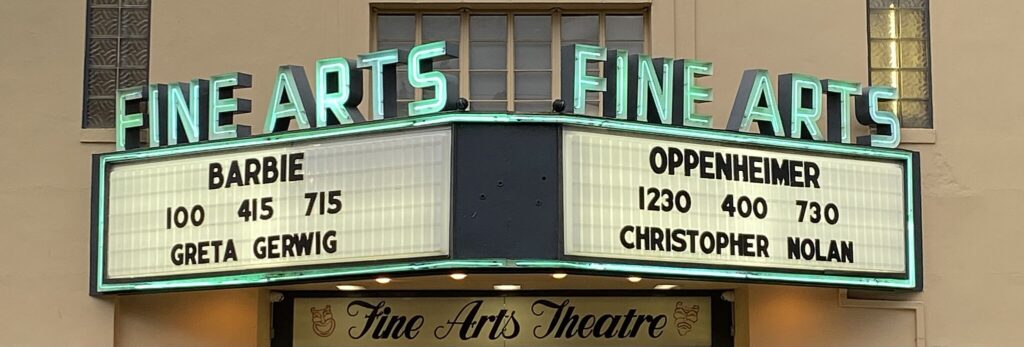
when barbie met oppenheimer at the summer box office in 2023, it sparked a veritable explosion of memes, discussions, and general hubbub. both debuting over the same weekend, the films were quickly merged into a wider “barbenheimer” phenomenon that brought millions to the cinema. at a recent seminar, postdoctoral researcher julia empey invited her audience to look well past the initial glitter and glam of the movies, and argued that the two halves form a distinctly american whole: their mythologised narratives of power and progress dress up as critique, hiding the cracks of a late-capitalism breakdown. the two films then are not just intertextually tied to each other, but also ideologically entangled with postwar american capitalist culture.

plastic and plutonium represent, at their heart, two neatly-packaged ideological products, both idealising a culture of individualism and nationalism. greta gerwig’s partnering with mattel immediately destabilises the liberation from gendered expectations that she had heralded during the press run ahead of the film’s release; on the other hand, nolan’s framing of oppenheimer—and more widely of what would become the nuclear arms race—seems to grapple with the consequences of a tragic genius, but ultimately fails to shed the mythical portrayal of the man.
in both cases, we are left with aesthetics of critique rather than genuine confrontation. the system that is meant to be criticised is actually reinforced: barbie’s rebellion and character arc still fits neatly in the limits of a corporate-approved feminism, her self-discover leads to nothing deeper than a puddle of consumer-friendly “girlboss” empowerment. in her review for the michigan daily, erin evans aptly notes that:
The whole film is desperate to make us aware how self-aware it is.
and thus breaks any sort of immersion that it had managed to build. on the other hand, nolan flirts, but ultimately ghosts true self-reflection, as his american exceptionalism triumphs over any sort of moral quandary, albeit chastened by the protagonist’s regret. barbenheimer is an ideological dyad, where both toy and bomb function in the same way in the collective imagination. empey herself said that:
Assemblages [are] a fragmentary whole, and I’m interested in particular how assemblages can and must be understood as being both networked but also simultaneously hierarchical. And further, the word assemblage connotes specific imagery. Barbie and the bomb are both assembled, and then unleashed upon the world.

both barbie‘s plastic and oppenheimer‘s plutonium are manufactured—mass-produced, globally exported, and tightly controlled in their message, soft and hard powers made manifest. but it could not be any other way: to deviate from this message would simply not fit within the narrative of supporting, however subtly, american cultural hegemony. we are offered a spectacle of artificial spaces where nothing changes: barbie discovers herself, and her image is still used to conform and perform femininity; oppenheimer is remorseful, but the bomb is still built, and we remain under its shadow.
there is really no better summary for barbie than tarpley hitt’s insightful review:
The end product of Barbie is obviously a commercial, so maybe it’s not worth thinking too hard about the politics of a film that clearly is designed to give a languishing commodity more market interest and to extract even more value from Mattel’s existing IP.
what is more, we are forcibly reminded and convinced that it is the individual who represents the driving force behind history. collective progress does not sell in a society that thrives on isolating its members: instead we are presented with monumental problems—war, patriarchy, secular misogyny—and abstract, individual solutions. “learn about feminism”, “learn to live with your failures”. late capitalism profits off the blandest appeareance of subversion, which is stripped of any real revolutionary quality and then promptly repackaged into a product we can buy, filling our lives with “i am kenough” hoodies, “i am become plastic” t-shirts, quirky posters and memeable stories. maybe hitt is right, maybe it’s not worth thinking too hard about the politics behind the phenomenon. and maybe, any attempt at thinking “too hard” has already been anticipated, marketed, and sold.
sources:
evans, erin “‘Barbie’ gets worse and less feminist when you push past the jokes”. the michigan daily, 26 july 2023, https://www.michigandaily.com/arts/film/barbie-gets-worse-and-less-feminist-when-you-push-past-the-jokes/
Hitt, Tarpley. “The Muddled Feminism of Greta Gerwig’s ‘Barbie.’” The Nation, 27 July 2023, https://www.thenation.com/article/culture/barbie-greta-gerwig-film-review/.
longmore, sean. “barbenheimer”. layered butter, https://layeredbutter.com/editorial/barbenheimer.
ryanai6. “barbenheimer on display”, wikimedia commons, https://commons.wikimedia.org/wiki/File:Barbenheimer_on_display.jpg

travis, ben. “How The Barbenheimer Phenomenon Ruled The Box Office”. empire, 25 july 2023, https://www.empireonline.com/movies/features/how-barbenheimer-ruled-the-box-office/.
Leave a Reply