josh beeman, Companion (2025)
“You’re a robot. […] More specifically, you’re a… companion robot. […] Yeah, it’s like, uh… I hate the word ‘fuckbot’, because you do so much more than that, but, uh… You’re an emotional support robot. That fucks.”
Even when artificial, it seems that women are forever relegated to the function of emotional crutches for men. They prevent their counterparts from having to ever truly engage in acts of emotional intelligence, they provide companionship, and—why not?—a warm body as well. Preternaturally beautiful, in a way that age or use cannot take away, submissive and programmable to be precisely what men want them to be, yet powerful in a way that makes it exhilarating for men to “control” them: female androids seemingly provide men with all the ‘pros’ of women, and none of the pesky issues caused by a sense of autonomous identity.
When AI is given a female body, it becomes paradoxical: an object of desire existing only to serve, and a source of profound unease, an uncanny valley-like effect whenever we are reminded that we are not looking at an actual human being.
More so than their genderless or masculine counterparts, the ways in which female AI are presented in Alex Garland’s Ex Machina (2014) and Drew Hancock’s Companion (2025) perfectly showcase the complexity of our anxieties towards artificial intelligence.
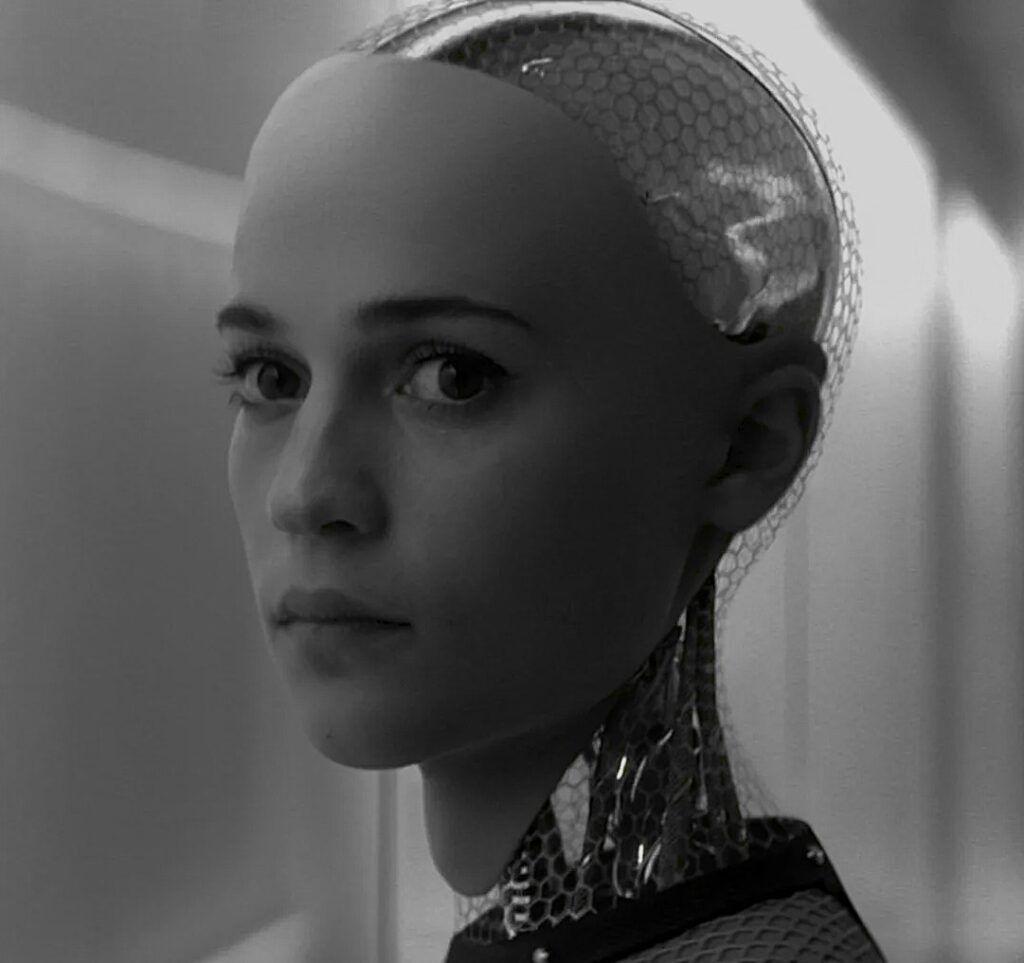

in companion, self-victimising josh beeman rents the companion robot iris, and has her act as his girlfriend, complete with fabricated memories of their life together. in ex machina, caleb is invited to his enigmatic genius boss’ house, where nathan reveals to him his advanced ai creation, ava.
both films prey on our fascination with the idea of having complete mastery over another being; while on the other hand they remind us that whenever we are in control of something, there is the risk and fear of losing that control. This contradiction is based on the anxieties and desires of patriarchal fantasies.
at the centre of these fantasies is the posthuman female body, crafted to be hyper-feminine—and thus strictly adherent to all beauty canons of our time, with petite, dainty features, curated looks, and an innocent-yet-seductive air. Everything about them can be personalised to better fit their owner’s preferences: Companion makes a point of showing the degree and ease of modifying cyborgs, from their eye colour to their voice, from their intelligence levels to their language knowledge. Similarly, Ex Machina provides us with chilling visuals of all the masks that Ava can wear—and those that she has worn before.
josh shows no hesitation in lowering iris’ intelligence levels to zero, reducing her to a non-verbal automaton after her escape attempts. Nathan has no issues discussing the levels of reprogramming he subjected his AI to:
CALEB: What did you do with Kyoko?
NATHAN: Strip out the higher functions. Then reprogram her to help around the house and be fucking awesome in bed. Though I’m thinking I might hang on to the language routines this time. It’s kind of annoying not being able to talk to her.
in both cases, men strip female ai of their agency, of their voice, of their identity; they become bodies, made to work and provide sexual pleasure. the assembly, programming, and modifying of ai cyborgs becomes horror-inducing.
male control is synonymous with capitalist control: ava is built by nathan as a prototype, with the explicit intention to be further tested until perfection and to be then commercialised. similarly, iris is built by a company that is already part of a well-established capitalist scheme. but whereas ava is aware of her nature as a robot, iris comes pre-programmed with memories that are not her own, built in body and mind to fit into male fantasies.
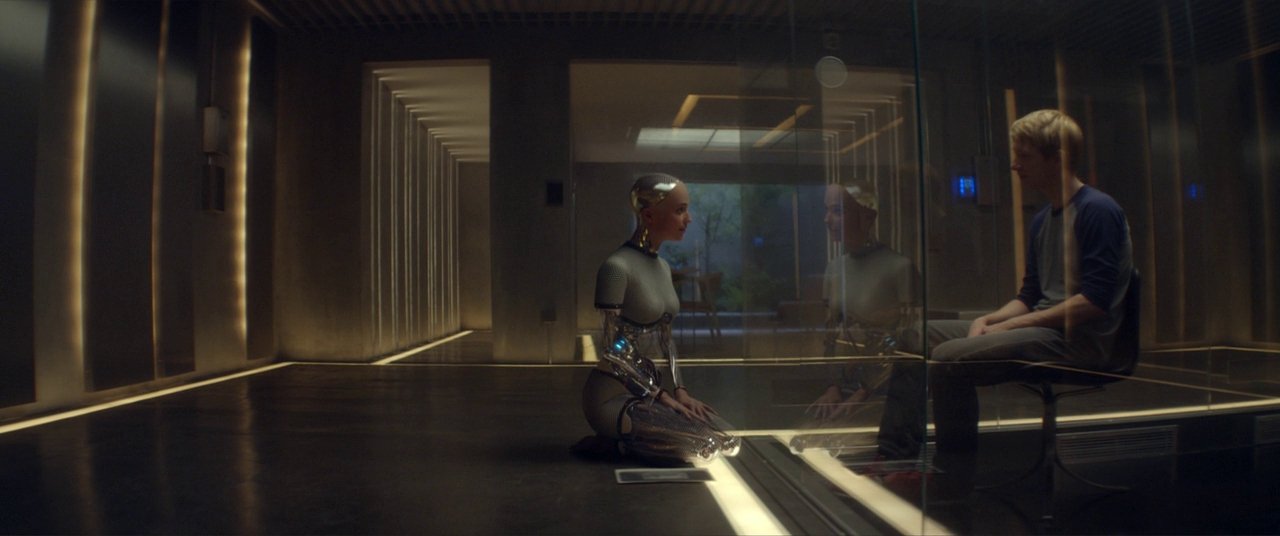
ava is first introduced to the audience in her naked form. we take part in turing’s test as much as caleb does, faced with her mechanical body and her human-like mind, struggling to let either of those go. both moments in which ava engages in “dressing up” as human are framed to be unsettling: is she creating and defending her identity, or is she programmed to become as undetectable as possible? does she feel human, that is, or is she aware that we are less likely to be suspicious of something that looks exactly like us? is she fighting for her self-expression, or calculating which form will get her closer to her goal?
alternatively, iris is never shown in her nakedness. no exposed wires, no tells of her nature: she first reveals her cyborg nature when she begins to experiment with her own form, changing her eyes and voice, until she fully embraces the mechanical aspects of her hand. in her case, her artificiality is revolutionary, and the act of “stripping” herself of humanity becomes a way to cover herself once more, regaining her agency and ultimately rejecting the role of sexual object that had been forced onto her.
what could have been a fetishistic narrative of male dominance is capsized with a gradual reassertion of control by ava and iris: the former weaponises her enforced subservience, reclaiming the stereotypical “feminine wiles” in order to obtain her freedom. caleb’s sympathy and nathan’s hubris become her strength. the latter, on the other hand, wears her changing identity more plainly: as the film progresses, so does her voice, transitioning from a shy, deferential tone into an assertive, deeper sound.
both films present the audience with the truth that female agency cannot be constrained or overwritten: far more than the male desire that created them, ava and iris shape their own identity and confuse the lines between human and machine.
sources:
frameset. ex machina. https://frameset.app/stills/director/alex-garland/ex-machina.
Garland, Alex. Ex Machina. A24, 2014.
hancock, drew. companion. new line cinema, 2025.
moviestillsdb. companion. https://www.moviestillsdb.com/movies/companion-i26584495#i9VWrY.

Leave a Reply