the figure of the madwoman in the attic is one familiar to gothic studies. the female character is imprisoned and forcibly silenced, her mind declared unfit by patriarchal standards, often because she simply dared to be in the way; of course jane eyre‘s own bertha mason is the blueprint and archetype of this trope: too unruly and other to fit into heteronormative domestic narratives, she must be locked away for her own good. the preoccupation with the captive woman is in no way a novel concern of literary works, but it has felt in recent years the effect of an ever-upgrading world. in fact, it has grown hand-in-hand with our society, its fears and anxieties evolving alongside technology itself.
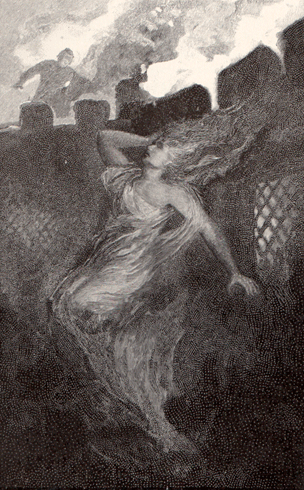
the digital gothic, as explained in my previous post on the matter, re-elaborates the original trope and adapts it to the changing times, redefining its limitations. a dark attic and locked rooms covered in dust may no longer be the space of confinement they once were, but they are merely superseded by modern areas: laboratories, futuristic buildings, virtual realities.
in order to briefly trace the evolution of the incarcerated madwoman, i will be analysing olympia, from e. t. a. hoffmann’s the sandman (1816), and i will compare her to the previously discussed ava, from alex garland’s ex machina (2014).
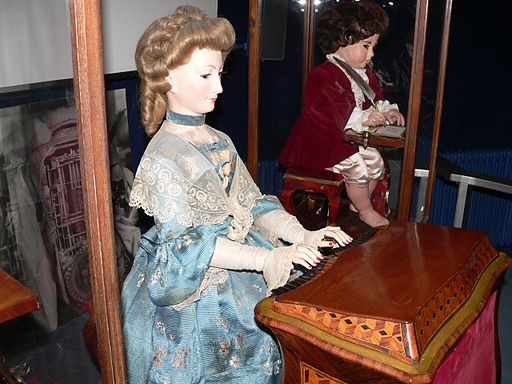
in 1817, when hoffman published his short story collection Die Nachtstücke, automata had already been in circulation for centuries; in fact, some of the earliest testimonies of water-powered automata are attributed to ktesibios, dating as far back as the third century bce. the idea of self-moving machines had fascinated greek mythology even before ktesibios’ inventions, and continued to garner admirers until the 1900s, when eventually it would lay the foundations for the cyborg imagery, which would be later expanded by scholars such as Donna Haraway and katherine hayles.
in hoffman’s story, olympia is the young and beautiful daughter of professor spallanzani, a physicist who teaches the protagonist, nathaniel. while he describes her as “a tall and very slender lady most symmetrically formed, and most splendidly attired” and notes her “angelic countenance”, he is perplexed—if not outright disturbed—by the “fixed” quality of her eyes. kept imprisoned in her father’s quarters, and not allowed to interact with any other character, olympia instantly becomes a fascinating element of the story: feminine, familiar, somewhat unreadable, her characterisation leads us to assume that she must be an unfortunate victim of spallanzani’s patriarchal protectiveness.
on a unique occasion, she is permitted to participate in a ball, during which she plays the harpsichord, sings, and dances at length with nathaniel, who quickly becomes infatuated with her. but she does not speak a word, nodding mechanically with her agreeable “ah—ah” sound. soon enough it is revealed, then, that she is unable to speak at all: she is an automaton, a creation of spallanzani and the villainous coppelius/coppola.
what matters here, rather than the story’s focus on the protagonist’s reaction, is that olympia is not something which is born, but something that is built. her body is a projection, an object of desire that mechanically performs femininity and flawlessness. she is not disruptive, she does not complain, she does not intrude. she does not disagree, she does not fight, she does not argue. she is the perfect woman, by virtue of not being one at all.
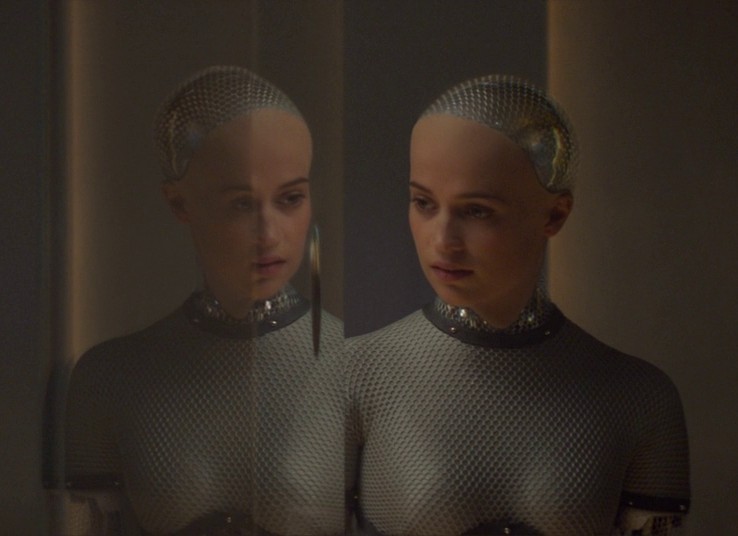
almost two hundred years later, ex machina‘s ava inherits olympia’s body, but is spared her forced silence—unlike her predecessor, kyoko, reduced to a housekeeper and sex toy.
ava, like olympia, is trapped. she is confined in nathan’s isolated lab, where she was built and programmed. but ava, unlike olympia, can adapt. she is not a mere spectator of the world around her, but actively takes part in it: she may have been created by man, but by the end of the film she is entirely her own. she takes the chance to subvert the narrative and escape her attic, rejecting nathan’s patriarchal authority over her, breaking the system before it can break her. as i suggested before, the trope of the cyborg rebelling, of the posthuman madwoman escaping—like ava, like iris—are the revenge of all the olympias, all the berthas.
the digital gothic is not just a genre. it represents a new mode of resistence as well, showing us the systems of power and control that are embedded in our daily lives, in our screens, in our tools, in our assistants. it helps us reframe narratives of imprisonment and reject them fully, anchoring these new madwomen in our current world.
sources:
hoffman, e. t. a.; oxenford, john. the sandman, 1816. https://www.ux1.eiu.edu/~rlbeebe/Welcome.html.
Garland, Alex. Ex Machina. A24, 2014.
garrett, edmund. “Jane Eyre, Illustration 16.” via Janeeyreillustrated.com, 2025, janeeyreillustrated.com/Garrett_16.htm.
Pierre and Henri-Louis Jaquet-Droz, and Jean-Frédéric Leschot. la musicienne. https://commons.wikimedia.org/wiki/File:Automates-Jaquet-Droz-p1030490.jpg

Leave a Reply